Alex Henderson
Journalist, Political Reporter, Cultural Critic, Editor/Proofreader
Alex V. Henderson
Philadelphia, PA
vixenatr

- Home
- Articles on Political, Social, Legal and Business Topics

- Political Commentaries
- Arts & Entertainment
- Bios For Record Companies: Rock
- Bios For Record Companies: Jazz Instrumentalists
- Bios for Record Companies: R&B and Hip-Hop
- Bios For Record Companies: Jazz Vocalists
- Liner Notes, Jazz Instrumentalists
- Liner Notes: Jazz Vocalists
- Magazine Articles: Jazz
- Magazine Articles: R&B
- Liner Notes: R&B
- Liner Notes: Hip-Hop
- CD Reviews
- Travel Photos
- Technical Writing
- Blogs
- Links
FunkyTownGrooves,
November 2013
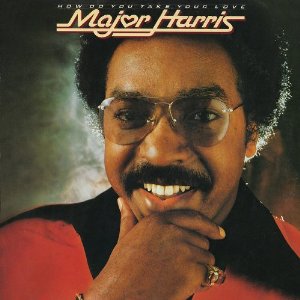 Major Harris
How Do You Take Your Love
When lovers of Philadelphia soul are asked to name the late Major Harris’ crowning achievement, the answer is obvious: Harris is best remembered for the sexy 1975 ballad “Love Won’t Let Me Wait,” which soared to #1 on Billboard’s R&B singles chart and #5 on the Billboard Hot 100 in the United States (it was a #37 hit in the UK) and was certified gold in the U.S. for sales of over half a million copies. Harris’ smash went down in history as a definitive example of romantic Philly soul, and “Love Won’t Let Me Wait” had such an impact that it was later covered by the likes of Johnny Mathis & Deniece Williams in 1984, Luther Vandross in 1988, Nancy Wilson in 1994, John Legend in 2005 and Seal in 2012.
Philadelphia was not Harris’ hometown: he was born in Richmond, Virginia on February 9, 1947. It was in Philly, however, that he recorded “Love Won’t Let Me Wait” and enjoyed his greatest commercial success—and while “Love Won’t Let Me Wait” became his signature song, Harris had other accomplishments as well. In the early 1970s, Harris was a member of one of Philly soul’s most important vocal groups: the Delfonics, who he left in 1974 to concentrate on his solo career. And he had a few minor or medium-sized solo hits after “Love Won’t Let Me Wait,” including “I Got Over Love” (which made it to #24 R&B in Billboard), “It’s Got to Be Magic” and “Laid Back Love” in 1976 and “All My Life” in 1983. Also, he was a first cousin of the late Philly producer Norman Harris, who was famous for his work with Blue Magic, Loleatta Holloway, the Trammps, First Choice, Barbara Mason and many others. In fact, Blue Magic’s 1974 smash “Sideshow” was written by the same duo that wrote “Love Won’t Let Me Wait”: Vinnie Barrett, a.k.a. Gwendolyn Woolfolk, and MFSP guitarist Bobby Eli.
In 1978, Major Harris recorded one of his lesser-known albums, How Do You Take Your Love, for RCA Records. Produced by Jerry Ragovoy, a.k.a. Norman Meade, in New York City—not at Philly’s legendary Sigma Sound Studios, where Harris had recorded his previous albums, My Way in 1975 and Jealousy in 1976—How Do You Take Your Love doesn’t have an all-Philly cast. The participants include, among others, the ubiquitous session player Sammy Figueroa on percussion and Alfa Anderson, Diva Gray and Luther Vandross on background vocals. At the time, Vandross was two years away from performing with the group Change and three years away from launching his solo career but was keeping busy as a session vocalist—and Anderson and Gray were both part of a New York City-based band that Change were heavily influenced by: Chic, who were huge in 1978 (the year in which their song “Le Freak” hit #1 on both the pop and R&B charts in Billboard). Anderson was one of Chic’s lead singers, and Gray sang background on many of their hits.
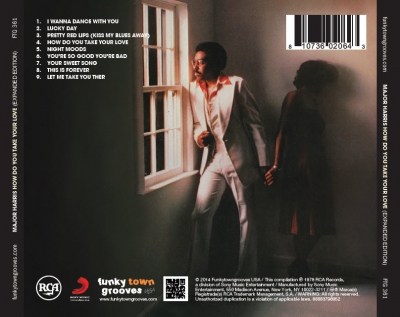
But while this reissue wasn’t recorded in Philly, it certainly has the Philly sound—and that includes six songs that Ragovoy wrote or co-wrote: “Night Moods” (which Chaka Khan recorded in 1981), “Pretty Red Lips (Kiss My Blues Away),” “You’re So Good, You’re Bad,” “I Wanna Dance With You,” “Lucky Day” and the title song. Most of those selections are slow jams, but the 10-minute “I Wanna Dance With You” brings together Philly soul and Philly disco and manages to be laid back one minute and exuberant the next. “I Wanna Dance With You” starts out as a slow ballad and stays that way for about four minutes; then, Harris increases the tempo considerably and turns the song into a lush but funky disco-soul workout.
Ragovoy himself was a native of Philly (where he was born on September 4, 1930), although he moved to New York City and enjoyed most of his success outside of Philly. And he had an impressive résumé in both R&B and pop-rock. The long list of famous songs that Ragovoy wrote or co-wrote along the way includes “Time Is on My Side” (a hit for Irma Thomas and the Rolling Stones), “Piece of My Heart” (a song closely identified with Erma Franklin, who was Aretha Franklin’s older sister, and Janis Joplin), “Stay With Me” (a major hit for Lorraine Ellison in 1966), “Get It While You Can” (recorded by Howard Tate) and “Cry Baby” (which was recorded by Garnett Mimms and later, Joplin).
On this reissue, the Philly influence is also evident on the songs that Ragovoy didn’t write or co-write, including the slow jams “Let Me Take You There” and “This Is Forever” and the perky, energetic “Your Sweet Song.” The latter has a strong Spinners influence, recalling early 1970s hits like “One of a Kind (Love Affair)” and “Mighty Love.” The Spinners were not from Philly: they were a Detroit group and spent much of the 1960s at Motown Records. But many of the major hits they had at Atlantic Records during the 1970s were recorded in Philly under the direction of producer/songwriter Thom Bell, and “Your Sweet Song” is very much in the vein of Bell-era Spinners.
After How Do You Take Your Love, Harris didn’t do a lot of recording as a solo artist. However, 1984 saw the release of his solo album, I Believe in Love, which came out in the U.K. on the Streetwise label but went unnoticed in the United States. The 1990s and 2000s found Harris reunited with the Delfonics and performing with that group extensively again.
Ragovoy was 80 when complications from a stroke ended his life on July 13, 2011. And on November 9, 2012, Harris died of heart and lung failure at the age of 65 in his home town of Richmond, VA. He continued to be closely identified with Philadelphia soul right up until the end, and as How Do You Take Your Love demonstrates, recording outside of Philly certainly didn’t prevent Harris from being faithful to the Philadelphia sound.
—Alex Henderson, November 2013
Alex Henderson’s work has appeared in Billboard, Spin, Creem, The L.A. Weekly, JazzTimes, Jazziz, Salon.com, AlterNet, Cash Box, HITS, CD Review, Skin Two, Black Beat, The Pasadena Weekly, Black Radio Exclusive (BRE), Music Connection, Latin Style, The New York City Jazz Record, Jazz Inside Magazine and many other well-known publications. Henderson (alexvhenderson.com) also contributed several thousand CD reviews to The All Music Guide’s popular website and series of music reference books.
Alex V. Henderson
Philadelphia, PA
vixenatr