Alex Henderson
Journalist, Political Reporter, Cultural Critic, Editor/Proofreader
Alex V. Henderson
Philadelphia, PA
vixenatr

- Home
- Articles on Political, Social, Legal and Business Topics

- Political Commentaries
- Arts & Entertainment
- Bios For Record Companies: Rock
- Bios For Record Companies: Jazz Instrumentalists
- Bios for Record Companies: R&B and Hip-Hop
- Bios For Record Companies: Jazz Vocalists
- Liner Notes, Jazz Instrumentalists
- Liner Notes: Jazz Vocalists
- Magazine Articles: Jazz
- Magazine Articles: R&B
- Liner Notes: R&B
- Liner Notes: Hip-Hop
- CD Reviews
- Travel Photos
- Technical Writing
- Blogs
- Links
New York City Jazz Record,
February 2018
Interview: Leni Stern
By Alex Henderson
When Leni Stern recorded her first album as a leader, Clairvoyant (Passport, 1985), she established herself as a lyrical and melodic jazz-rock fusion guitarist whose influences included Pat Metheny, John McLaughlin, Bill Frisell and Jim Hall. Stern has also embraced everything from pop-rock to world music and her exploration of West African rhythms continues on her latest recording 3, due out in April on her LSR label. It features Stern on guitar, ngoni (a traditional West African string instrument) and vocals and spotlights her working trio of bassist Mamadou Ba and percussionist Alioune Faye.
Born Magdalena Thora in Munich, Germany, Stern moved to Boston in 1977 to attend Berklee College of Music and has been based in New York City since 1981. Stern discussed her passion for African music and some of the highlights of her long career in a recent interview.
The New York City Jazz Record: 3, unlike some of your other African-influenced projects, was recorded in New York City but sounds like it was recorded in West Africa.
Leni Stern: I guess I’ve learned, from all the great African engineers in the African studios I’ve recorded in, how to get that type of sound—and how that sound is produced. I’ve learned how to make that acoustic sound come out of the African drums and the ngoni. The African engineers know how to get that type of sound because they record those instruments every day but over here people don’t record those instruments every day.
TNYCJR: When did you learn to play the ngoni?
LS: I learned it about 11 years ago in Mali when I went to play the Festival in the Desert in 2007. I had an ngoni teacher, Bassekou Kouyate, who I have featured on many of my records. The ngoni is like a little brother to the guitar.
TNYCJR: You’ve been singing in various African languages, including Bambara and Wolof, and sing in different languages on 3.
LS: On this album, I only sing in two: English and Wolof. I don’t sing in Bambara on this album. Altogether, I don’t sing that much on this record. This is more like a guitar-playing and ngoni-playing record than a vocal record. It has six instrumental tracks and two vocal tracks. I’m only singing in two languages on this album because there was less opportunity to sing. This record is a little bit of a return to my instrumental angle.
TNYCJR: You composed most of the songs?
LS: Most of them. Some of them we composed together. “Assiko”, for example, started with a drum break.
TNYCJR: Even though 3 wasn’t recorded in Senegal—unlike your last album, Dakar Suite, from 2016—it maintains a strong Senegalese influence.
LS: The compositions are based on African rhythms. Two-thirds of the trio are from Senegal. So, the album has a very strong West African influence. And all jazz does come from Africa, originally.
TNYCJR: One of the songs, “Colombiano”, has some South American influence as well.
LS: South America was very heavily influenced by African rhythms because the Spanish guys could not have conquered South America without the African slaves. The African rhythms came to South America and “Colombiano” is actually an homage to a Colombian percussionist, Samuel Torres, who comes and sits in with my band sometimes. We would say, “Samuel Torres, the Colombiano, is going to come and play with us today.” Also, “Colombiano” is a tribute to the influence of Africa in South America and the Colombian sense of melody and harmonic movement. We just did a tour of South America and we really strongly felt the connection to African music.
TNYCJR: What was the inspiration for “Khavare”? LS: Khavare literally means party. The song uses a traditional rhythm of Senegal called mbalax and it’s called “Khavare” because anywhere in the world you find Senegalese people, you find sabar parties—even here in New York. Actually, all over the world. It starts usually at midnight and they dance until the sun comes up. That’s what inspired that song “Khavare”: the Senegalese sabar parties that go all night long. You have to play your drums six hours or so. The rhythm of “Khavare” is based on the call to the sabar party. That’s how you start a sabar party: with that kind of rhythm and that kind of call.
TNYCJR: And “Wakhma”?
LS: The scale used on “Wakhma” is a little bit Arabic. In Mali, they sing so many beautiful love songs that have that type of Arabic scale, which you find in Spanish music also. In Spain, flamenco is based on Arabic scales as well and “Wakhma” is played on the ngoni and is dedicated to that scale. I tried to create one of those longing songs that shows the Arabic influence on West Africa. The Moors conquered West Africa and brought Islam to West Africa; Islam is not the original African religion.
TNYCJR: Another track is “Barambai.”
LS: Barambai is the name of a rhythm and it’s the rhythm that is traditionally played in Africa at the ceremony for the naming of a baby. In Africa, after a baby is born, they wait ten days—or like two weeks—before they decide which aunt or uncle that baby is going to be named after. Then there is a party where the name of the baby is announced. You have drinks, presents, cakes and food at the baby-naming ceremony. And when I learned the ngoni in Africa, I played at those parties.
TNYCJR: How about “Spell”?
LS: There are original spells that I learned in Africa. I was initiated into the African traditions. They don’t just teach you how to play the ngoni; you have to learn the whole tradition. And I studied all that...being a griot in Africa is considered a cultural responsibility. And traditionally, you’re born into it. But somebody who is born into it can have a student who is not born into it. I was a student.
TNYCJR: You are really delving into the customs and traditions of West Africa.
LS: It’s so interesting. You know, so many people suffer from the illusion that Africa is just a jungle where people sit in trees and are barbarians. But Africa had empires when Europeans were still hanging on trees. Germanic tribes, my own, were barbaric while Africa already had empires and musical songs that are played to this date. Africa has choral arrangements that are thousands of years old. People justified slavery by saying, “We saved those savages.” Those were not savages; those were empires with huge traditions. And those traditions are still alive in spite of what colonialists did to them. They are still alive in song and art. I found it so interesting to collect African songs.
TNYCJR: Are there other parts of Africa you would like to explore musically?
LS: I don’t really know yet. I’ll let that happen as it naturally happens. But I think this album became very Senegalese because we played in Senegal a lot and I got to meet a lot of musicians from Senegal through my band members. I’ve also met a lot of people from Mali. And on some of my other records before, there was music from Nigeria. I’ve played with a talking drum player from Nigeria and I have learned some of those rhythms. So, I never know where life takes me next.
TNYCJR: There is so much different music to explore.
LS: Oh God, there are so many rhythms in African countries. There is a wealth of music in every country in the world. And there are so many folk rhythms from Germany, where I was born. Certainly, they have very, very interesting rhythms in the Slavic countries like Bulgaria. The great thing about music is that it doesn’t recognize any boundaries or any borders; you can mix them all up and come up with a new, brilliant form of music.
TNYCJR: How much practice does it take to sing in African languages such as Bambara and Wolof? LS: It takes a lot of practice, but the members of my current band speak Wolof to each other. They just fall into it. I picked it up from them and I can speak Wolof a little bit. We’ve traveled to Senegal; you can pick up Wolof traveling in Senegal. And I’ve learned how to speak Bambara playing in Malian bands.
TNYCJR: In what respects do you feel you’ve evolved as a guitarist?
LS: I think I’ve found my own voice on the guitar and I’ve made peace with it. I don’t want to copy anybody. It’s hard to find your own voice, but it’s a pursuit worth pursuing, I would say.
TNYCJR: You studied with Bill Frisell early on.
LS: I had a lot of good teachers, but Bill was one of the most interesting ones because he would speak in riddles. Bill’s not a guy who talks a lot. He wouldn’t explain it, whereas my husband, Mike Stern, likes to talk.
TNYCJR: You’ve played with your share of great jazz musicians over the years, from Dennis Chambers to Michael Brecker.
LS: When I first came back from playing at the Festival of the Desert in Mali, Michael Brecker was so excited and wanted to play on my first African record [Africa, LSR, 2007]. I said, “Yes! You can play on my record” and Michael was so into it. Michael had studied African music and he encouraged me to continue in that direction. I miss Michael very much.
TNYCJR: You also played with David Sanborn.
LS: I would go to David’s house and we would play standards together. When David found out I was making a record [in 1989], he said, “Oh, why don’t you let me play on it?” And I said, “Absolutely.”
TNYCJR: That was Closer to the Light on Enja Records in 1989.
LS: I remember that the president of the label couldn’t believe that David Sanborn was going to play on my record. They were very happy.
TNYCJR: You also played with Paul Motian.
LS: Paul enjoyed playing with [late pianist] Geri Allen and he enjoyed playing with me. Paul enjoyed playing with women; I always got the feeling that he really liked it. He just liked playing with women and he didn’t see what the big deal was. But the labels were like, “Why does Paul want to play with girls? They’re second-class citizens. Why does he want to play with them?” I was so sad when Paul Motian passed away.
TNYCJR: These days, there are so many skillful female instrumentalists achieving recognition in jazz.
LS: More and more are coming out.
TNYCJR: In the ‘50s-60s, it was often assumed that if a woman was a jazz musician, she was a singer.
LS: Yes, there were some piano players who were made to sing. Nina Simone was a piano player and the record companies were like, “You’ve gotta sing.” And she said, “OK, I’ll sing.”
TNYCJR: And Shirley Horn was an excellent pianist even though she is best remembered for her vocals.
LS: Yes, they were excellent female piano players, but the record companies didn’t see a way of selling that. That’s why I’m so glad that the music industry has changed and there are so many opportunities for all kinds of unusual things. The internet has really allowed people to choose what they like, not what some record label has pre-picked for them. The artist chooses themselves. There’s still marketing and all that, but much less than there used to be. It’s wonderful. It’s much more democratic now.
TNYCJR: You’ve been based in NYC since 1981. In what ways has the city’s jazz scene evolved over the years?
LS: The music has changed and developed. With the internet, musicians were afraid that people wouldn’t want to come out to hear live music. But now, with the streaming, live music is like the cool thing again. The new generation loves to come and hang out. Some of the old venues are gone, but there are always new ones. New York has always been, and always will be, a live music city.•••
For more information, visit lenistern.com. Stern is at Club Bonafide Feb. 8th, Shrine Feb. 10th, 55Bar Feb. 13th and Barbès Feb. 14th. See Calendar.
Recommended Listening:
• Leni Stern—Clairvoyant (Passport Audio-JDC, 1985)
• Leni Stern—Closer to the Light (Enja, 1989)
• Rebecca Coupe Franks—Suit of Armor (Justice, 1991)
• Wayne Krantz—Separate Cages (Alchemy, 1996)
• Leni Stern—Africa (MRI/LSR, 2007)
• Leni Stern—Dakar Suite (LSR, 2016)
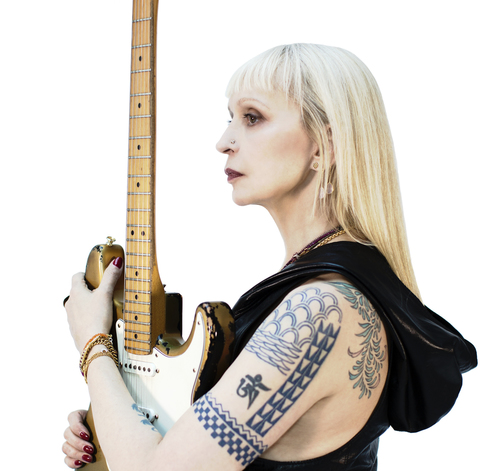
Photo by Sandrine Lee

Copyright 2022 Alex V. Henderson. All rights reserved.
Alex V. Henderson
Philadelphia, PA
vixenatr