Alex Henderson
Journalist, Political Reporter, Cultural Critic, Editor/Proofreader
Alex V. Henderson
Philadelphia, PA
vixenatr

- Home
- Articles on Political, Social, Legal and Business Topics

- Political Commentaries
- Arts & Entertainment
- Bios For Record Companies: Rock
- Bios For Record Companies: Jazz Instrumentalists
- Bios for Record Companies: R&B and Hip-Hop
- Bios For Record Companies: Jazz Vocalists
- Liner Notes, Jazz Instrumentalists
- Liner Notes: Jazz Vocalists
- Magazine Articles: Jazz
- Magazine Articles: R&B
- Liner Notes: R&B
- Liner Notes: Hip-Hop
- CD Reviews
- Travel Photos
- Technical Writing
- Blogs
- Links
The New York City Jazz Record,
August 2012
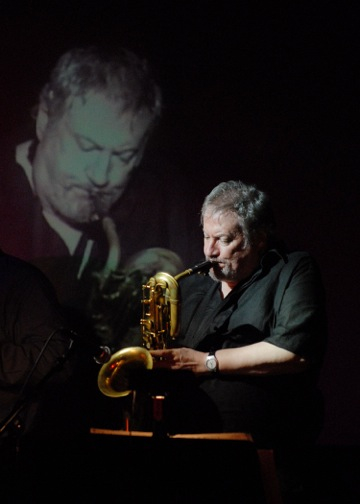
Interview:
Ronnie Cuber
by Alex Henderson
No one can accuse Ronnie Cuber of not having a diverse résumé. In the jazz world, the baritone saxophonist is known for his associations with George Benson, Maynard Ferguson, Woody Herman, Lee Konitz, Dr. Lonnie Smith and the Charles Mingus ghost band, among others. But while Cuber, now 70, is a straightahead hard bop/post-bop musician first and foremost, he has played numerous rock and R&B sessions along the way. During a recent interview, the native New Yorker looked back on his long career and reflected on his far-reaching contributions to music.
The New York City Jazz Record: You’ve played not only straightahead jazz, but also done session work for Billy Joel, Gladys Knight & the Pips, Tori Amos, The Spinners, Chaka Khan, Sinéad O’Connor and countless others. How did your tastes become so eclectic?
Ronnie Cuber: When I was a teenager in the ‘50s, I was exposed to a lot of R’n’B and rock ‘n’ roll: Fats Domino, Little Richard, Bill Haley and His Comets. I was a teenager during the [disc-jockey] Alan Freed period. I was exposed to jazz during my first year of high school and I could see the similarity between the jazz records, the R’n’B records and the rock ‘n’ roll records I was listening to. I could see that the blues were a jumping off point for a lot of jazz and R’n’B and rock ‘n’ roll. And I would notice the saxes when I watched "American Bandstand." That was an exciting time.
TNYCJR: So the fact that you had diverse tastes as a teenager paved the way for your ability to play a hardbop date one minute and play with Luther Vandross or Frank Zappa right after that?
RC: I haven’t really gotten into one corner, you know what I mean? When Luther was still alive, I would always get calls for his record dates. But I would always come back to the bebop thing. I liked the way the Brecker Brothers had the jazz phrasing with the rock beat and when groups like Weather Report came around, I loved the music that Joe Zawinul and Wayne Shorter wrote. But any time that I tried to do something like that myself, I would always wind up back in the bebop thing. It always felt more natural to me to be playing straightahead. I liked electric bass, but it had to be in the right setting. My ideal is an acoustic bass and a piano with Latin percussion and drums.
TNYCJR: In addition to your other credentials, you have a long association with Latin music.
RC: Jazz always had some kind of Latin element to me. It was natural for me to incorporate Latin into jazz. I played with a lot of Latin bands, mostly with Eddie Palmieri back in the ‘70s. And I’m still getting work with Eddie. I’ve also been doing the Latin Side series with Conrad Herwig at the Blue Note in New York.
TNYCJR: One of the most unique groups you played with was George Benson’s ‘60s quartet with [Dr.] Lonnie Smith on organ. Having a baritone sax in an organ combo certainly wasn’t the norm at the time.
RC: No. With the organ groups in the ‘60s, it was usually tenor, guitar, organ and drums—and maybe alto. But very rarely would you see baritone sax in an organ group. George Benson’s manager back then saw something in me when I was jamming around Harlem. He asked me to come and play with George, who liked what I was doing, and George’s group became a unique group within the organ group genre.
TNYCJR: By the time you joined Benson’s quartet, the baritone had become your primary instrument.
RC: And it still is, although I started on clarinet. When I was like nine years old, my father bought me a clarinet and when I got to high school, I got a tenor sax. Then, when I left high school, I auditioned for a band called the Newport Youth Band. Marshall Brown held auditions at his club on 86th Street and Park Avenue. I went up there with my tenor and he said, “Yeah, kid, great. But I got a million zillion tenor players. Would you consider playing baritone?” I thought about it for a minute and said, “Yeah, but I don’t have a baritone.” And he said, “If I buy you one, will you play one?” Then the guys in the band said, “You’ve gotta get this Pepper Adams vibe.” And I bought all of Pepper Adams’ records and the records he did with Donald Byrd.
TNYCJR: You’ve been quoted as saying that tenor players like John Coltrane, Sonny Rollins and Eddie “Lockjaw” Davis had a greater influence on your baritone playing than Pepper Adams. Do you think that being a baritone player with mostly tenor influences made your playing distinctive?
RC: Oh, of course, sure - being a tenor player first and then picking up the baritone. I liked a lot of tenor players: Dexter Gordon, Gene Ammons, Trane, Hank Mobley, Tina Brooks. So many tenor players had an involvement in my baritone playing.
TNYCJR: When you started playing the baritone in 1959, there weren’t that many baritone players in jazz. The list included Cecil Payne, Pepper Adams and Leo Parker in hardbop, Harry Carney in Duke Ellington’s band and Gerry Mulligan in the Cool School. Serge Chaloff had died in 1957. Gerry Mulligan was considered the baritone equivalent of Stan Getz.
RC: Well yeah, I really liked the things that Gerry Mulligan did with the piano-less quartet with Chet Baker. When I started playing baritone, there were so many tenor players and alto players; for every 50 tenor players or every 50 alto players, there was maybe one baritone player. But nowadays, there are more students learning baritone sax. And there are more girls playing the baritone. For example, there’s a girl that plays in the Mingus Big Band: Lauren Sevian. When I did a clinic in Boulder, Colorado, one of the baritone players who took a private lesson with me was a girl named Rebecca Buxton, who is living in New York now.
TNYCJR: One of your gigs that wasn’t specifically jazz-oriented was the time you spent in the Saturday Night Live Band in the early to mid ‘80s. You were on "SNL" during the show’s Eddie Murphy period.
RC: Yeah, Eddie was so talented. When I got there, the show was kind of going down the tubes. "Saturday Night Live" wasn’t getting very good ratings and NBC was about to cancel it. Then they brought in another producer, Dick Ebersol, who hired Eddie Murphy and Joe Piscopo. After a few weeks went by, the ratings started coming up again.
TNYCJR: You turned 70 last December. You have witnessed many changes in the way music is distributed and consumed: 78s to vinyl LPs to CDs and now the popularity of digital downloading. What were your early record-buying experiences like?
RC: When I started buying records, I would go from Brooklyn into Manhattan and pick out the records that I liked. Or I would pick out a record just from the look of the album cover. You couldn’t play the record to get a sample. So I would buy a record hoping it was a good one—and most of the time, it was. The Blue Note record covers had a real style that no other label had. I would listen to a record like The Jazz Messengers at the Café Bohemia with Hank Mobley, Kenny Dorham, Horace Silver and Doug Watkins. And when I was listening to the two volumes, I would hold the cover in my hand and imagine that I was in the club.
TNYCJR: If physical CDs do go the way of the LP and all new albums become digital-only, many long-time jazz listeners will miss the experience of having something physical to hold in their hands. But there are many people who’ve never bought a physical CD. They’ve only bought digital downloads.
RC: True. I miss Tower Records. I used to go to Tower Records on Broadway at 66th Street to see what was new. They would have a whole section of records that had just been released and it was fun to walk in and see what was available. Now, I even find myself downloading one track at a time, but I do believe that there is something about having text and photos to go with music.
For more information, visit ronniecubermusic.com. Cuber is at Smoke Aug. 17th-18th. See Calendar.
[As of press time, Cuber’s dates have been cancelled]
Recommended Listening:
• George Benson - The George Benson Cookbook (Columbia-Legacy, 1966)
• Ronnie Cuber - Cuber Libre! (Xanadu, 1976)
• Ronnie Cuber - Live at the Blue Note (ProJazz, 1986)
• Horace Silver - The Hardbop Grandpop (Impulse-GRP, 1996)
• Mingus Big Band - Live in Tokyo At the Blue Note (Sue Mingus Music-Sunnyside, 2005)
• Ronnie Cuber - Ronnie (SteepleChase, 2009)

Photos by René Dissel

Alex V. Henderson
Philadelphia, PA
vixenatr