Alex Henderson
Journalist, Political Reporter, Cultural Critic, Editor/Proofreader
Alex V. Henderson
Philadelphia, PA
vixenatr

- Home
- Articles on Political, Social, Legal and Business Topics

- Political Commentaries
- Arts & Entertainment
- Bios For Record Companies: Rock
- Bios For Record Companies: Jazz Instrumentalists
- Bios for Record Companies: R&B and Hip-Hop
- Bios For Record Companies: Jazz Vocalists
- Liner Notes, Jazz Instrumentalists
- Liner Notes: Jazz Vocalists
- Magazine Articles: Jazz
- Magazine Articles: R&B
- Liner Notes: R&B
- Liner Notes: Hip-Hop
- CD Reviews
- Travel Photos
- Technical Writing
- Blogs
- Links
FunkyTownGrooves,
October 2013

Chocolate Milk
Blue Jeans' [Expanded Edition]
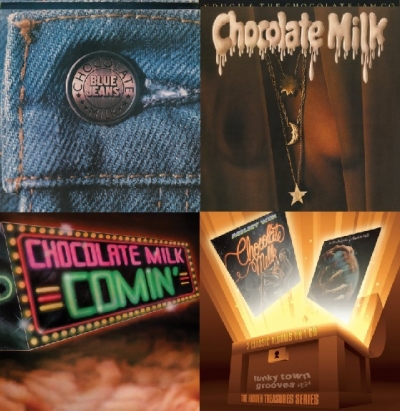
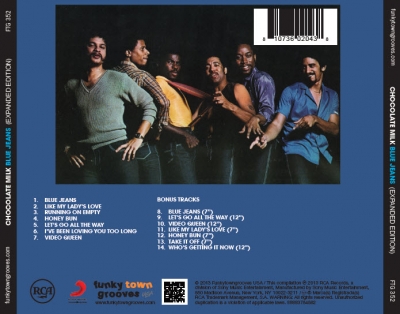
1980 was a year of transition for Chocolate Milk. That year, they parted company with the New Orleans icon they had been working with extensively for half a decade: producer/songwriter Allen Toussaint. And they opted to leave New Orleans, moving their recording base to Los Angeles and, after that, Memphis. It was in Memphis that Chocolate Milk recorded their seventh and next-to-last album, Blue Jeans. Released by RCA Records in 1981, Blue Jeans demonstrated that there was life after Toussaint and life after the Crescent City for the funk/soul outfit.
It would be difficult to overstate how important Toussaint (who turned 75on January 14, 2013) had been to Chocolate Milk. Formed in New Orleans in 1974, Chocolate Milk soon became Toussaint’s studio band—a position previously held by the Meters—and Toussaint began producing their recordings with the help of his partner, Marshall Sehorn (who passed away in 2006). Toussaint was a huge name in New Orleans soul, having written songs that became major hits for Ernie K-Doe (“Mother-in-Law” in 1961), Lee Dorsey (“Working in a Coal Mine” in 1966), Chris Kenner (“I Like It Like That” in 1961) and many other Crescent City artists. Toussaint’s magic touch wasn’t limited to New Orleans, however: he co-produced Labelle’s 1974 classic “Lady Marmalade,” and he even crossed over to country-pop when his song “Southern Nights” became a smash hit for Glen Campbell in 1977. “Southern Nights” soared to #1 on no less than three Billboard singles charts: country, pop and adult contemporary.
Chocolate Milk worked with Toussaint on their first five albums: Action Speaks Louder Than Words in 1975, Chocolate Milk and Comin’ in 1976, We’re All In This Together in 1977 and Milky Way in 1979. Under Toussaint’s direction, Chocolate Milk favored a sound that contained both New Orleans and non-New Orleans influences. Chocolate Milk were often compared to the Meters, which was appropriate considering that the Meters were also a funk/soul band from New Orleans—and, to be sure, the Meters were a strong influence. Yet Chocolate Milk also had non-New Orleans influences that included Dayton’s Ohio Players, Jersey City’s Kool & the Gang, Oakland’s Tower of Power and Chicago’s Earth, Wind & Fire (that is, Chicago by way of leader/founder Maurice White’s adopted home of Los Angeles).
That combination of New Orleans and non-New Orleans influences resulted in some hit singles here and there—most notably, “Action Speaks Louder Than Words” (a #15 R&B hit in Billboard) and “Girl Callin’” (which reached #14 R&B in Billboard and became their biggest hit). But Chocolate Milk never had a Top 10 R&B hit in Billboard, and they were never as famous as Cameo, Slave, LTD or Rose Royce (all of which were major funk/soul bands that emerged in the 1970s). So in 1980, Chocolate Milk were feeling frustrated and decided to try something different. Parting company with Toussaint and leaving New Orleans were not decisions they took lightly, but they hoped the gamble would pay off.
1980’s George Tobin-produced Hipnotism was their first post-Toussaint, post-New Orleans album and their sixth album altogether. Hipnotism wasn’t the big across-the-board breakthrough Chocolate Milk were hoping for: the album stalled at #69 on Billboard’s R&B albums chart, and the single “Hey Lover” only made it to #40 R&B. But in 1981, Chocolate Milk’s seventh album, Blue Jeans (which was produced by Allen A. Jones) outperformed Hipnotism and reached #22 on Billboard’s R&B albums chart. The infectious title track fared as well as “Action Speaks Louder Than Words” and almost as well as “Girl Callin’” when it became a #15 R&B single in Billboard.
With its references to early 1980s designer jean makers like Jordache, Calvin Klein and Sassoon, the infectious “Blue Jeans” single embraces a time-honored theme in R&B, rock, hip-hop and country: women in tight-fitting denim. “Blue Jeans” recalls the Ohio Players’ 1974 hit “Skin Tight,” also hinting at the Commodores’ “Brickhouse”—and Chocolate Milk provide some equally sweaty funk on “Honey Bun” and “Running On Empty.”
But Blue Jeans isn’t a funk album exclusively. “Like My Lady’s Love” and “I’ve Been Loving You Too Long” are both romantic soul ballads, although they are quite different. While “Like My Lady’s Love” has an Earth, Wind & Fire-ish melody, “I’ve Been Loving You Too Long” is an inspired remake of a Memphis soul classic that the late Otis Redding wrote and made famous in 1965 (when it became a #2 R&B smash in Billboard). Chocolate Milk’s decision to cover Redding’s gem on Blue Jeans made perfect sense in light of the fact that this album was recorded in Memphis.
“Video Queen” is an interesting surprise: the song blends funk with new wave rock, sounding like a cross between the Ohio Players and the Talking Heads. And on the bouncy #41 R&B hit “Let’s Go All the Way,” there are hints of the Solar Records sound (which, in 1981, was huge thanks to artists like the Whispers, Lakeside, Shalamar and Dynasty).
FunkyTownGrooves’ expanded 2013 edition of Blue Jeans contains seven bonus tracks, including the 7” single versions of “Honey Bun,” “Video Queen,” “Like My Lady’s Love” and the hit title track. Also offered as bonus material are the single versions of “Who’s Getting It Now” and “Take It Off,” both of which are from 1982’s Friction and find Chocolate Milk exploring a more keyboards-oriented style of funk.
In the early 1980s, some of Chocolate Milk’s fans wondered if they made a mistake by parting company with Toussaint and leaving New Orleans. However, as it turned out, those decisions didn’t hurt them commercially but didn’t give them a significant commercial boost either. Post-Toussaint and post-New Orleans, Chocolate Milk continued to be a band that was capable of occasionally reaching the R&B top 15 in Billboard but not the R&B top 10.
After Blue Jeans, Chocolate Milk recorded one more album, Friction, before breaking up in 1983. Chocolate Milk never achieved the huge mega-hit they were hoping for, but that didn’t make them any less funky—and there is no shortage of funkiness on Blue Jeans.
—Alex Henderson, October 2013
Alex Henderson’s work has appeared in Billboard, Spin, Creem, The L.A. Weekly, JazzTimes, Jazziz, Salon.com, AlterNet, Cash Box, HITS, CD Review, Skin Two, Black Beat, The Pasadena Weekly, Black Radio Exclusive (BRE), Music Connection, Latin Style, The New York City Jazz Record, Jazz Inside Magazine and many other well-known publications. Henderson (alexvhenderson.com) also contributed several thousand CD reviews to The All Music Guide’s popular website and series of music reference books.
Alex V. Henderson
Philadelphia, PA
vixenatr